Annual Appeal
Donate to the Annual Fund

by FOF member Chris Duerksen
With permission, we are sharing Chris’ article about fishing in the Fakahatchee, which was published in the Florida Sportsman magazine. To read more of this great article go to https://tinyurl.com/fishing-the-fak.
“The Fakahatchee Strand Preserve offers a trifecta of freshwater lakes, brackish canals and ponds, and saltwater tidal creeks with a smorgasbord of fish ranging from Junker largemouth and peacock bass, to snook and tarpon, not to mention outsized oscars and hard-fighting redfish”.

 You don’t have to get your feet wet or drive your car down Janes Scenic Drive to see the wonders of the Fakahatchee Strand Preserve State Park.
You can ‘leave the driving to the us’ – by day or by moonlight – when you sign up for one of the Friends of Fakahatchee Tram Tours. If you want to get your feet wet, our Introduction to Swamp Walk with Tram Tour combines the best of both worlds.
Register Now for Tours and EventsThe ‘Ghost Rider’ tram, named in honor of the famous Ghost Orchid found in the Park, allows you look at wildlife and plants without having to watch the road. The 20-passenger tram is wheelchair accessible, and some seats face backwards.
An experienced guide leads each 2 1/2 hour tram tour and points out interesting aspects of the park. The tour takes you past wet prairie where you’ll learn about the underlying geology that shapes the landscape. It stops at a slough to give you a window into the strand. It gives you the opportunity to take a guided 15-minute walk down an old logging path to see numerous air plants, a variety of ferns, and seasonally blooming orchids.
This is an outdoor event, so please dress appropriately for the weather; wear secure, closed toe shoes for brief walks at tram stops.
The Ghost Rider Tram Tour is $25 per person. For more information, to see available dates, and to purchase tickets visit the Eventbrite page for the Fakahatchee Ghost Rider Tram Tour.
On a Moonlit Fakahatchee Tram Tour you can view the magnificent Fakahatchee Strand Preserve State Park under the illumination of a full moon. These tours start just as the sun is setting – prime time for photography and spotting some of the mammal residents of the Strand as well as birds settling in for the evening.
Experienced naturalists lead each tram tour and will introduce you to denizens of the night, including fireflies, bats and owls. City-dwellers will be amazed at how their vision changes as their eyes adapt to the light the moon provides. Evenings can be quite cool when the Moonlit Tour is offered. Check the weather report and dress appropriately for the night of your tour.
The Moonlit Tram Tour is $35 per person. For more information, to see available dates, and to purchase tickets visit the Eventbrite page for the Moonlit Tram Tour.
 The roseate spoonbills appeared at the midpoint of the festive groundbreaking ceremony at the Big Cypress Bend Boardwalk the morning of December 7. Someone shouted “Spoonbills!” and everyone’s gaze shifted from the speaker’s podium to the skies above.
High in the bright blue morning sky, glowing pink from the sun behind them, a pair of roseate spoonbills glided in silent formation above the Fakahatchee. The words of the speakers at the ceremony were eloquent, but the silent presence of the birds above spoke volumes about the importance of the project far below them.
For the day, the abandoned road east of the boardwalk entrance took on a festive air complete with assisted parking, coffee, rolls, fruit, programs, display boards and shiny groundbreaking shovels ready to plunge into piles of imported earth.
Before the program, members of the Friends of Fakahatchee mingled with Fakahatchee park staff, representatives from other nature groups, tourism and local political officials and returned snowbird friends. The formal program was a testament to the coalition of state and local officials and dedicated FOF volunteers that was necessary to keep the project alive and finally get it off the ground.
One name mentioned by every speaker was Tom Maish, former FOF president and the man who championed the project for the past thirteen years.
“…a great success and thanks for all your work on this project and event. Very exciting for Fakahatchee after all these years!”
– Former President Patty Huff
FOF President Patrick Higgins welcomed attendees to “a momentous day for the Friends, the Park, the county and the state. He said the project, which includes safe parking, restrooms, a bridge across the canal and the park’s first interpretive center, “would have a significant economic impact on the county.”

Park Rangers Mike Duey, Guy DiGiovanni, and Steven Bass, Assistant Bureau Chief BJ Givens, State Senator Kathleen Passidomo, Director of Parks Eric Draper, Collier County Commissioner Donna Fiala, Park Manager Steve Houseknecht, Bureau Chief District 4 Valinda Subic, Park Biologist Mike Owen, Florida Division of Recreation & Parks Assistant Director Chuck Hatcher.
Collier County Commissioner Donna Fiala told the group that “tourism focusing on the environment” is the wave of the future. “The enthusiasm for this project that the Friends of Fakahatchee volunteers expressed was beautiful,” she said. “I just opened the door.”
State Senator Kathleen Passidomo praised the strong partnership between the park service and the FOF. She said she was convinced of the need for improvements when she saw people trying to cross US 41 on foot from the existing parking lot on the other side of the road. When she discussed the project with the Friends, she said she was “blown away” by the plan, asking “how much do you need?”

One name mentioned by every speaker was Tom Maish, former FOF president and the man who championed the project for the past thirteen years.

Patrick Higgins, Francine Stevens, Collier Visitors Bureau Executive Director Jack Wert, Tom Maish, Visitors Bureau PR & Communications Manager JoNell Modys.
 Keynote speaker Eric Draper, director of the Florida Park System, told attendees “look around at this remarkable state park. That’s the real keynote today.” After praising the contributions of Tom and Judy Maish at Corkscrew Swamp and the Fakahatchee, he told the group “we walk in the footsteps of other leaders like Mel Finn, Nathanial Reed, Franklin Adams and Jane Parks. Without their individual efforts years ago, where we are standing today could well have been another Cape Coral…Instead you are laying more footsteps— building a place where visitors will be inspired to protect land in our great state of Florida.”
Moments later, eleven dignitaries lined up and grasped their shovels. As they tossed clumps of soil into the air, cameras and cellphones captured the symbolic scene.

Ready, set, go! Chris Whipple, David Corban, Francine Stevens, Patrick Higgins, Kathleen Passidomo, Eric Draper, Donna Fiala, Tom Maish, Valinda Subic, BJ Givens, Steve Houseknecht
“Congratulations on putting together a truly memorable event… The FOF is a remarkable organization and a template for CSO’s around the state.
As pressures mount threatening our environmental integrity, the health, sustainability, and continued growth of our Park System is crucial. Eric Draper and I have been through many wars together, and I know that he was much impressed by, one, the quality of staff, and, two, the turnout of members. Again, well done.”
– Former President John Elting

Boardwalk Vision Committee Extraordinaire with Eric Draper: Francine Stevens, Tom Maish, Jimene Rinehart, Glen Stacell, Eric Draper, Patrick Higgins, Kit Kitchen-Maran, John Kaiser, Bruce Bunch.

This billboard at the site of the groundbreaking ceremony honored those who helped make the Boardwalk Expansion Project a reality.
by Patrick Higgins
The other day I was leading a tour under a perfect blue sky across some rocks in the recently dried-out borrow ditch onto Lee Cypress Prairie. As we pushed through shoulder-high goldenrod on the far side, a bright green anole inspected us from perch just below the dried flower heads.

Green Anole surveying its surroundings. Photo by Patrick Higgins.
It made me recall as a child when every U.S. five-and-dime store sold green anoles as chameleons, along with baby red-eared turtles. Although our anoles can change color, chameleons they most certainly are not. Anoles are creatures of the new world and members of the Iguana family. They are very limited in their color palette compared to the rather prehistoric-looking true chameleons of Africa and the old world. These have feet with two toes facing forward and two back to better grip branches in common with parrots and woodpeckers, independently rotatable eyeballs, prehensile tails and famously, projectile tongues to seize their prey.
Our native green anole (Anolis carolinensis) seems mundane in comparison. It is however, very versatile and a remarkable survivor in the face of collection for the pet trade, habit loss and invasion by its cousin, the Cuban or brown anole (Anolis sagrei), native of course to Cuba, as well as to the Bahamas and nearby islands.
The natural distribution of green anoles is southeast United States from East Texas to North Carolina and the Florida peninsula. Ironically, they’ve been introduced and become invasive in Hawaii, Japan’s Ogasawara Islands and Guam, although in the latter, they in turn are now threatened by an introduced brown tree snake. There are also a few isolated introduced populations of greens in California.
Even through greens can turn brown, browns and greens are easily differentiated by head shape; the green has a longer, more slender snout, rather analogous to the difference between crocodiles and alligators. The short-snouted browns exhibit a great deal of color or rather brown variation. Females often have very distinct dorsal striping and the heads of juveniles sometimes an orange tinge. Browns can change color from brown to black, but not to green.
 Both species have foldable throat fans called dewlaps which they use for courtship and territorial display. On the brown this is usually orange, rimmed or speckled with yellow as shown in photo. (Photo by Patrick Higgins). Here in Southwest Florida we have our own green subspecies, the southern green anole, Anolis carolinensis seminolus that has a pale cream-colored dewlap in contrast to reddish dewlap of the more common and widespread northern green anole, Anolis carolinensis carolinensis.
Our anoles mainly feast on bugs and such, typically using a dash and seize technique that results in an appalling display of table manners as they chomp their prey with legs sticking out of the mouths in all directions. The introduced green iguana starts off as insectivorous but evolves into an herbivore as it matures much to the chagrin of Florida’s gardeners. Perhaps as a nod to their iguana relatives our greens occasionally lick nectar and eat pollen or even the odd flower petal.
The brown anole probably arrived in the Keys in the 1880s. A century later it had colonized the whole peninsula south of Gainsville. Movement of landscaping materials during Florida’s population boom rapidly spread their range. Browns now extend into Louisiana, westward as far as Houston and into central Georgia. Further northward expansion is currently limited by winter temperatures. As new arrivals they are more cold sensitive than the greens, but natural selection may breed this out, or climate change make it less relevant.
In areas where the they overlap, numbers of greens plummet as the two species compete for food and habitat. There is somewhat of a natural resource partitioning as browns are more terrestrial, favoring the ground and perhaps 3-5 feet above it, whereas the greens are distinctly more aboral favoring a higher zone with a slight overlap. Greens are creatures of the canopy. The rub is that both species have to come down to the ground to lay eggs, and browns are more prolific egg layers. I have greens in my suburban Naples yard because I have lots of vertical structure (trees) to create habit for them. Sadly, many Floridians favor a bare expanse of lawn with no room for greens.
Many visitors mistakenly refer to both species as geckos. I usually instruct them to grab a flashlight and check the eaves of their house after dark and they’ll soon see the difference; geckos have big eyes suited to a nocturnal life, padded suction cup-like feet, a very flat posture and squiggly running motion. Most of Florida’s geckos are introduced exotics. However, one could argue they’re not really invasive as they fill an unoccupied niche in our lizard-scape, mainly competing for prey in urban areas with our invasive Cuban tree frogs.
However, there’s a new threat, the knight anole (Anolis equestris) the largest of the anole family that grows up to 19 inches – another Cuban import that probably arrived in the 50s. When I first came to live in Florida in 2010, they were mostly confined to around Coral Gables’ Fairchild Botanic Garden, but within a few years I made the occasional sighting on the palms by Naples Pier and then one day I spotted something peculiar peering around the trunk of a Dahoon holly in my back yard.
 When I went out to investigate, it expertly played hide-and-seek as I walked around the tree, so that it was always tantalizingly on the opposite side. Finally, it made a dash for the canopy and I saw it was a huge green muscular lizard with very heavy jaws and a bright yellow flash on its shoulder. It was a knight anole, as shown on right (photo of Knight Anole climbing by Patrick Higgins).
Since then they’ve been regular visitors and are clearly breeding as I see a variety of sizes. They seem to establish a territory and do a regular circuit scouring all the trees in the area for tree frogs, bird nests and other anoles. They are completely aboral and never appear on the ground except to dash from one trunk to another. Fortunately, their range is very temperature dependent – if it falls to around 400 F they go comatose and drop to the ground. But beware; if you warm and wake them, they can be quite ferocious, hissing and biting!
In escaping the predation of the knight anole, greens may have a slight advantage over the browns as they are more agile in treetops and better able to utilize slick leaf surfaces. There has been some interesting work in evolutionary biology by Harvard’s Dr Jonathan Losos on this subject, utilizing anoles on isolated scrubby Bahamian islets that had either been swept bare of lizards by hurricanes or had them artificially removed. They first introduced brown anoles after painstaking recorded their limb dimensions, and then ground-dwelling curly-tail lizards that would predate upon them. The curly-tails forced the browns to move up in the bushes and clumsily use narrower vegetation to which they weren’t well adapted. Using other islets with no curly-tails as a control, Dr Losos and his colleagues were able to determine that within just a few generations the browns had evolved shorter limbs in an amazing example of rapid evolutionary change.
And yes, they can shed their tails to distract predators and regenerate them, but it’s not without cost. There’s the energy required to do so and then the tail does perform a function. It provides rotational stability when jumping and aids in balance.
The green anole on the goldenrod stalk decided I was watching him too intently and suddenly justified the expression ‘leaping lizards’ to disappear towards a nearby hardwood hammock, but it created an opportunity for a bit of instant interpretation and perhaps the inspiration for one of our group to create a bit of vertical structure and plant a tree in their backyard.
By Andrew Tyler
Whether you’re a regular seasonal visitor to Southwest Florida or a year-round resident, being here in 2018 one cannot fail to be struck by the changes in our floral landscape wrought by Hurricane Irma in September 2017. While many of the impacts on personal and community properties have been cleaned up, the effects on trees and their branches along the Boardwalk will be with us for a long time to come.
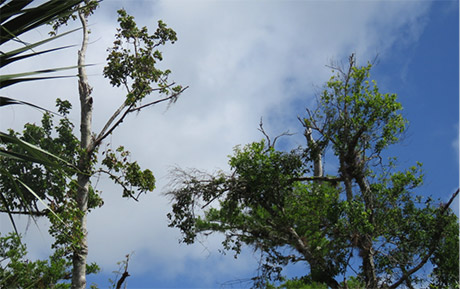
Blue skies and newly emergent spring growth above the Big Cypress boardwalk, where the loss of canopy is striking.
Examples abound in Naples. The inventory of the City Arborist shows that about 9% of all trees on City property had to be removed after the storm. A second example is the Naples Botanical Garden in East Naples. The devastation among the trees and plantings was cleaned up in fairly short order thanks to the Garden’s dedicated professionals, visiting arboreal specialists, and volunteers. What emerged was a landscape now lacking the extensive canopy shade that existed prior to Irma. Many of the perennial plantings, which had been strategically positioned to take advantage of each plant’s preferences for sun and shade now found themselves in a far sunnier spot, and most did not fare well.
With these thoughts in mind, the last Friday in March presented an opportunity for me to visit the Big Cypress Boardwalk. Visitors are thinning out and the perennial spring changes to our flora are underway. I had not been on the boardwalk often this season, so it was a good opportunity to observe what’s different this year.
You are likely well aware that some of the Friends of the Fakahatchee worked diligently to clear and repair the boardwalk and trail in the second half of September. The evidence of their hard work can only be fully appreciated when one compares what we see today with the scene immediately afterwards, documented in this report by Patrick Higgins. The new Chickee immediately adjacent to the start of the Boardwalk is a great addition. I noticed it being enjoyed by at least two parties of visitors during my visit.
Gazing into the sky, as with the Naples Botanical Garden, the loss of canopy cover is quite striking. While many of the big trees have survived the onslaught, a lot of branches must have been lost to allow through the amount of light we see today. The impacts of increased illumination on the vegetation below remain to be seen.
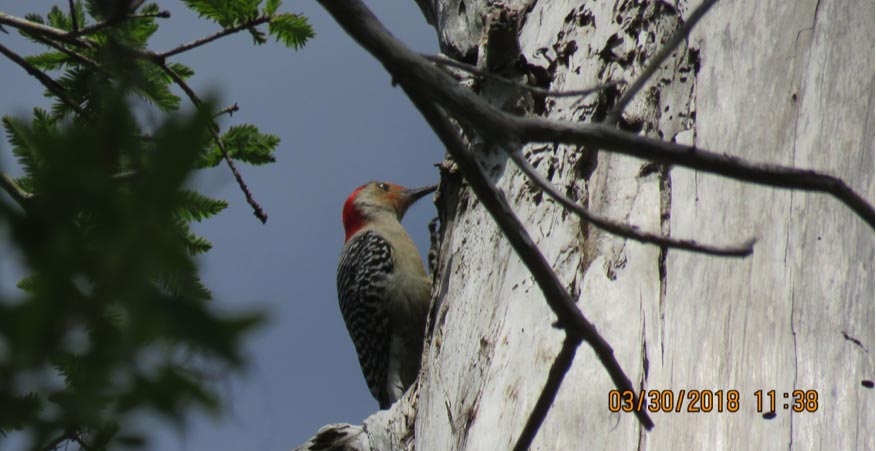
Red bellied woodpecker, much easier to see with less vegetation, inspect a pre-Irma dead tree, with newly-emerged Cypress needles in the background.
A ‘silver lining’ from the visitor’s perspective, however, is that it’s now much easier to see what’s going on in the lower-to-mid-levels of the vegetation. Whereas in the past one would hear a lot of scurrying around and bird activity, being able to identify their sources depended largely on luck and perhaps some knowledge of bird song. Today it’s much easier to see even the smaller birds scurrying around, and the views of the epiphytic plants are far superior.
We’re at the end of the usual Bromeliad blooming season, but there were numerous cardinal air plant (Tillandsia fasciculata) examples along the boardwalk still in full bloom. Raising one’s eyes from the ground, the epiphytes that enjoy the 10-20 ft off the ground zone are also thriving. Many of the needle-leaf epiphytes are showing that reddish tinge that goes with the time of year.
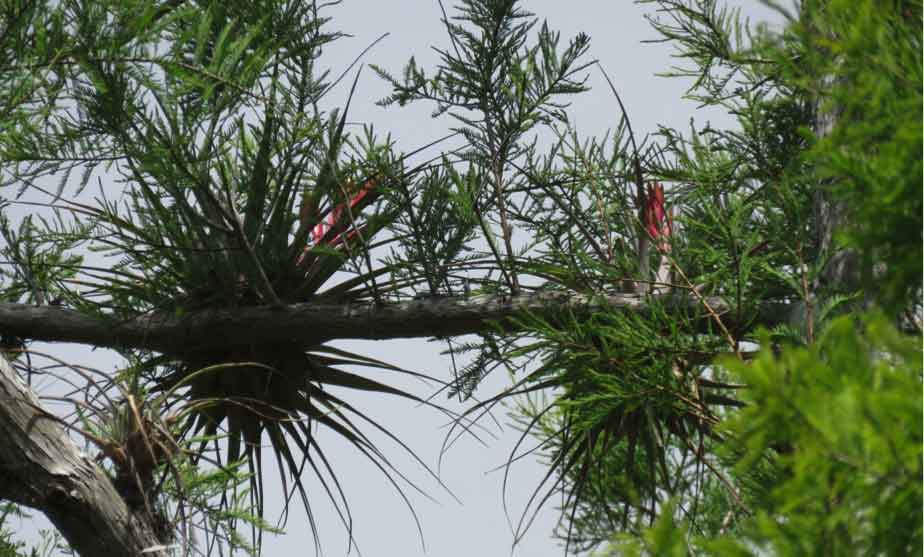
A collection of epiphytic bromeliads enjoying life in the upper canopy at Big Cypress Boardwalk.
There are two epiphytic dingy star orchids that live close to the far end of the boardwalk; one has red leaves and the other has green. Both were flowering on the day of my visit, and it is interesting to note that they are blooming somewhat later than the examples of the same species we observe on the weekly swamp walks 3 or 4 miles to the north. Why this might be is mere speculation, but they are thriving. One hopes that they continue to do so during the summer, since they will surely receive far more summer solar radiation now than a year ago.
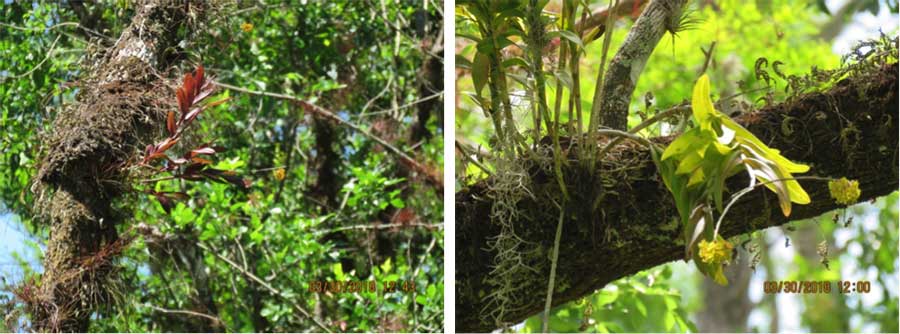
Two dingy star orchids (Epidendrum amphistomum), Red-leaved (left) and Green-leaved (right), in full bloom just off the boardwalk.
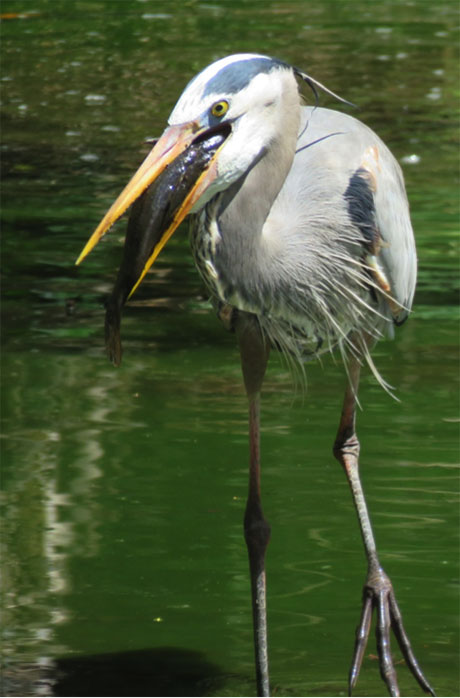
Blue heron enjoying a fresh fish lunch at the alligator hole.
At ground level I noticed a lot of ferns thriving in the areas currently lacking standing water. There have always been ferns here, of course, but whether they’re more noticeable because they enjoy the changed circumstances, or merely appear so because it is so much brighter remains to be seen.
Reaching the platform by the alligator hole, I noticed the local large alligator in mid-pool, just finishing lunch. My guess is it was a turtle, judging from the delicious ‘crunching sounds’ coming from the mouth end, but it declined to surface again for a photo opportunity.
A single blue heron was the only wading bird present and patience was rewarded, for the bird succeeded in catching a tasty fish for lunch. I’m always astonished at the seemingly impossible size of fish these birds manage to swallow. There seems to be a certain amount of stunning the fish (or killing it) by ‘slapping it around’ beforehand, presumably so that it doesn’t wriggle so much on the way down. This bird was kind enough to demonstrate, then pose dramatically for photo opportunities before finally downing the fish.
A family of Florida banded water snakes appeared to be in residence, and their relatively small sizes suggest that these are perhaps one year olds. I did not get an accurate count of their number; there was a lot of coming and going around their favorite log. I would estimate six animals visible during my stay.

A juvenile water snake enjoying a swim in the alligator hole. Fortunately the snake was a sufficient distance from the heron to avoid being a lunch target!
A striking difference this year is the color of the water in the alligator hole. The water is very obviously green. Presumably this is a result of increased light levels at the water’s surface allowing enhanced photosynthesis among both algae and small plants. Not my area of expertise, but the coloration seemed restricted to the water itself, as opposed to small clumps of duckweed, for example. This leads me to assume we’re looking at the results of enhanced algal growth.
Algal growth could have positive or negative consequences for life around the pond, or both, or none at all! Most Floridians are aware of ‘red tide’ at the beaches. Red tide is caused by marine algae Karenia brevis, that under certain conditions undergo rapid growth, a process also known as ‘blooming’.
Less well-known is the fact that freshwater algal blooms pose more of a human health threat. Some, but not all, species of freshwater algae can release chemicals that are highly toxic to most animals, including humans. These events can happen anywhere in North America. For example, Toledo, Ohio had to shut down its civic water supply in 2014 as a result of toxic algal blooms on Lake Erie.
These algal blooms are usually caused by abundance of nutrients and sunshine. In Florida, Lake Okeechobee annually suffers this problem to varying degrees, because of nutrients present in the lake’s waters as a consequence of local agricultural practices.
If the bloom uses up certain nutrients, it can cause the algae to die. Although algal blooms oxygenate water as a bi-product of photosynthesis, mass decomposition can lead to oxygen depletion and fish-kill. Blooms can also shade the aquatic plants growing beneath the surface and reduce their growth opportunities. It’s clearly very complicated, but it will be interesting to keep eyes on the alligator hole to see if there are any noticeable longer-term consequences to this mini-ecosystem.
I highly recommend taking some time to check out the Boardwalk of our favorite State Park before the mosquitoes hatch. I’d love to hear about your own observations.
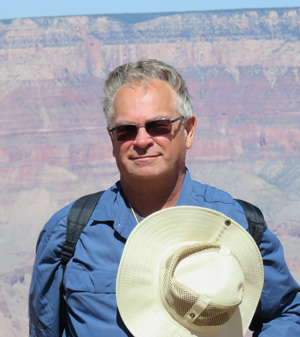
Andrew Tyler, shown here at the Grand Canyon, was elected to the FOF Board of Directors this spring.

New maps provide a clearer path to exploration.

.
New maps of the Park’s Hiking Trails and East River Paddling Trail are now available for download.
The new maps, in conjunction with information kiosks to be installed this summer, will encourage visitors to safely explore the wonders of our park. Look for the kiosks – funded in part through the Tourist Development Council Wayfinding Project – at the Visitor Center on Janes Scenic Drive, the East River access, West Main trailhead, East Main trailhead, and the Northeast corner of the park.
These maps were produced by Georgi Goldstein, intern to our architect for the Big Cypress Bend Boardwalk Expansion Project, David Corban. Our thanks for this generosity!
By Howard Lubel

Cigar Orchid Cyrtopodium punctatum bloom. Photo ©Rich Leighton
Finding a cigar orchid (Cyrtopodium punctatum) in flower is a stunning visual experience. Firstly, a mature plant can be enormous, reaching two feet or more in diameter with pseudobulbs measuring 15 to 20 inches in length. Secondly, the flowers are a vivid splash of yellow and brown that can number from 50 to in excess of 200 on a single plant at the same time.
Unfortunately, due to logging, poaching and other causes, these iconic orchids have become difficult to find in the Fakahatchee. It has been estimated that as few as 25 naturally occurring plants remained in the park’s 85,000 acres. Now with a little help from their friends, this dismal count is changing in the orchid’s favor.
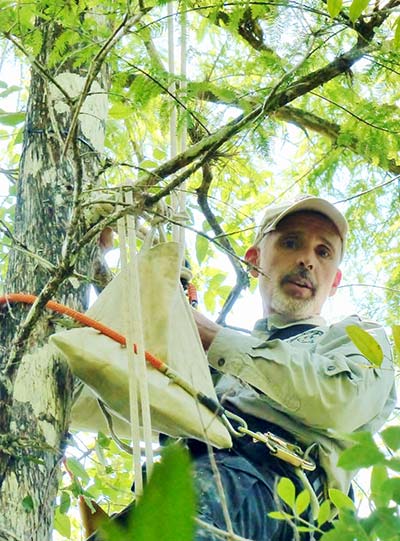
Dennis works on orchid restoration in 2009.
The cigar orchid restoration project in Fakahatchee was conceived in December 2006, when Matt Richards from Atlanta Botanical Garden (ABG) contacted then park manager and FOF board member, Dennis Giardina, about a collaborative effort to re-populate the park with these exquisite plants. Dennis and Park Biologist, Mike Owen, eagerly agreed. The project was about to begin.
Assessments of the remaining native plants were conducted by Mike and Dennis in a search for seed donors. A suitable donor, DG 19, was finally located and in 2009, a seed pod was collected and sent to Matt at ABG. Over the years other donor plants in Fakahatchee as well as a closely related plant in the Big Cypress were located. Unfortunately, one of our fellow human beings has since poached the Big Cypress donor. Seed pods were sent to ABG, seedlings became juvenile plants, were measured and documented and finally returned to Fakahatchee as pioneers in a grand experiment.
Between 2011 and 2015, approximately 200 juvenile cigar orchids were out-planted in various remote locations in the park by dedicated researchers and volunteers. The plants have been attached to cypress, pop ash and pond apple trees at various heights ranging from 4 feet to 20 feet. Watching Dennis Giardina climb a 30 foot tall cypress tree using ropes and a harness to attach a 6 inch tall plant to a sunlit home is to view parental love at its best. Approximately 1000 juvenile cigar orchids have now been re-introduced to the Fakahatchee through this collaborative effort.
The plants are monitored annually, although not all sites may be assessed each year due to time limitations and the remoteness of the out-planting locations. This year’s assessment began on April 16 under the supervision of Matt Richards and Mike Owen. Also lending support, expertise and sweat were Nick Ewy from Naples Botanical Garden and folks from Jacksonville Zoo and Gardens. Also, researchers from Florida International University collect and maintain data on each plant, Jay Staton along with FOF members Dennis Giardina and Karen Relish also slogged through the swamp, stepped over cottonmouths and carried ladders for untold distances to document the success of the project. The FOF Highlifter was used to transport folks to remote locations allowing for more time for monitoring the plants. While 2017 was a tough year for all plants in the Fakahatchee due to the effects of Hurricane Irma, it appears that we have presently an approximate 40% survival rate. Another 400 cigar orchids in the Fakahatchee would be a true success story.
So, what was the reward for spending 12 hours a day in the swamp, carrying ladders and collecting data nonstop while side stepping alligator poop? Well, some of us got to see three of our wild, native cigars in full flower. The largest of these was DG 19 with 172 flowers. Some of us got to see number 35, an out-planted cigar approximately 7 years old, with 50 flowers. Some of us got to see a ghost orchid two days away from flowering, an extremely early bloomer. All of us got to see the Fakahatchee, a remote, wild and truly beautiful place.
by Patrick Higgins
 It was some ten thousand years ago that the last ancestral Paleo-Indians were able to make the foot crossing from Asia into North America. Behind them the sea would have swallowed up the Bering land bridge as huge ice sheets reaching as far south as Manhattan Island melted and retreated.
When these hardy souls were trudging through a tundra-like landscape clad in furs, past scraggily spruce, dwarf willow and shrubby birch, perhaps following a herd of wooly mammoths, the Florida peninsula was almost twice as wide as it is today. But as sea levels continued to rise, Florida slowly shrank to its current shoreline. As it did so, the world’s climate became warmer and wetter, with our Everglades and precious Fakahatchee Strand developing about 5,000 years later.
For the past million years the Earth’s climate has alternated between warm interglacial periods of 10-20 thousand years and ice ages of some 80-90 thousand years. These climate oscillations correlate with what are called Milankovitch cycles. There are actually 3 different Milankovitch cycles at work, each with its own periodicity. They affect the shape of Earth’s orbit around the Sun from almost round to quite elliptical and therefore our distance from it, as well as the amount of tilt in Earth’s axis and the direction of that tilt. These all combine to vary the amount of solar energy Earth receives, which determines the advance and retreat of our glaciers.
A common question posed by our visitors is: how do we know that current global warming isn’t just part of this natural cycle? The answer is that these natural changes occur extremely slowly over a 100,000 year timeframe. So if the warming was the result of the natural cycle it should have taken many thousands of years instead of just the few hundred since the industrial revolution.
There’s another major difference, too: we know from ancient gases trapped in ice core samples that in prior interglacial warmings increases in CO2 levels lagged behind (followed) rises in temperature, which is what we would expect if the rise was from the natural Milankovitch cycles instead of from a rise in CO2. However, in our current warming the temperature rise is being led (preceded) by an increase in atmospheric concentrations of CO2.
You may also hear people talk about fluctuations in solar output. In fact, over the past 35 years of global warming the sun has shown a slight cooling trend, so recent warming cannot be attributed to changes in the Sun’s radioactive forcing either. Our insulating blanket of greenhouse gases has a bigger climatic influence than any slight fluxes in incoming solar energy anyway.
No skeptic has come up with a viable natural explanation for the magnitude of climate change that has occurred over the last few decades, whereas the unnatural answer of increased greenhouse gas emissions fits the bill. The physics of the greenhouse gas effect is beyond dispute.
The final question we may have to answer is this. If we know that our planet has survived past warming episodes, why does it matter? Because our entire civilization – where we can live, where we can grow food, what food we can grow, where and whether we’ll have sufficient water, our biodiversity and whether there’ll still be an Everglades – is all dependent on the climate we have experienced for the past 10,000 years.
We are now past the point of being able to stop change. We are just struggling to limit the amount and rate of change, so we and the natural world have time to adapt to it. And that’s just half of it. Right now we are being partially shielded from the full effects of our excess greenhouse gas emissions by the thermal inertia of our planet’s vast oceans. In a few decades we can really expect temperatures to take off.
